Can Your Team Disagree Without Coming Apart?

a leader contemplates their next move as teams debate an outcome over a round of tug-of-war

Two capable people disagree about a decision.

One sees a deadline the team cannot afford to miss. The other sees a risk the team cannot afford to ignore. Both care about the outcome. Neither feels heard.

Soon, the discussion shifts. People stop testing the idea and start questioning one another’s judgment. Others fall quiet. The meeting ends with a decision, but the tension follows everyone out of the room.

When AI Writes the Message, Who Earns the Trust?

AI, Communication & Leadership, a leader contemplates the message they are about to send.

A leader has difficult news to share. A decision has changed, a deadline has slipped, or a team member’s work has fallen short.

They ask AI to help draft the message. Seconds later, the words are clear, polished, and reassuring.

But there is a question worth asking before they press send:

Does this message sound like someone who understands what people are going through—and is prepared to stand behind every word?

AI can make writing faster. It can help organize a complex update, remove unnecessary jargon, and reveal where a message may be unclear. Those are useful capabilities. Yet leadership communication carries more than information. It carries responsibility for the decision, respect for the people affected, and a commitment to what happens next.

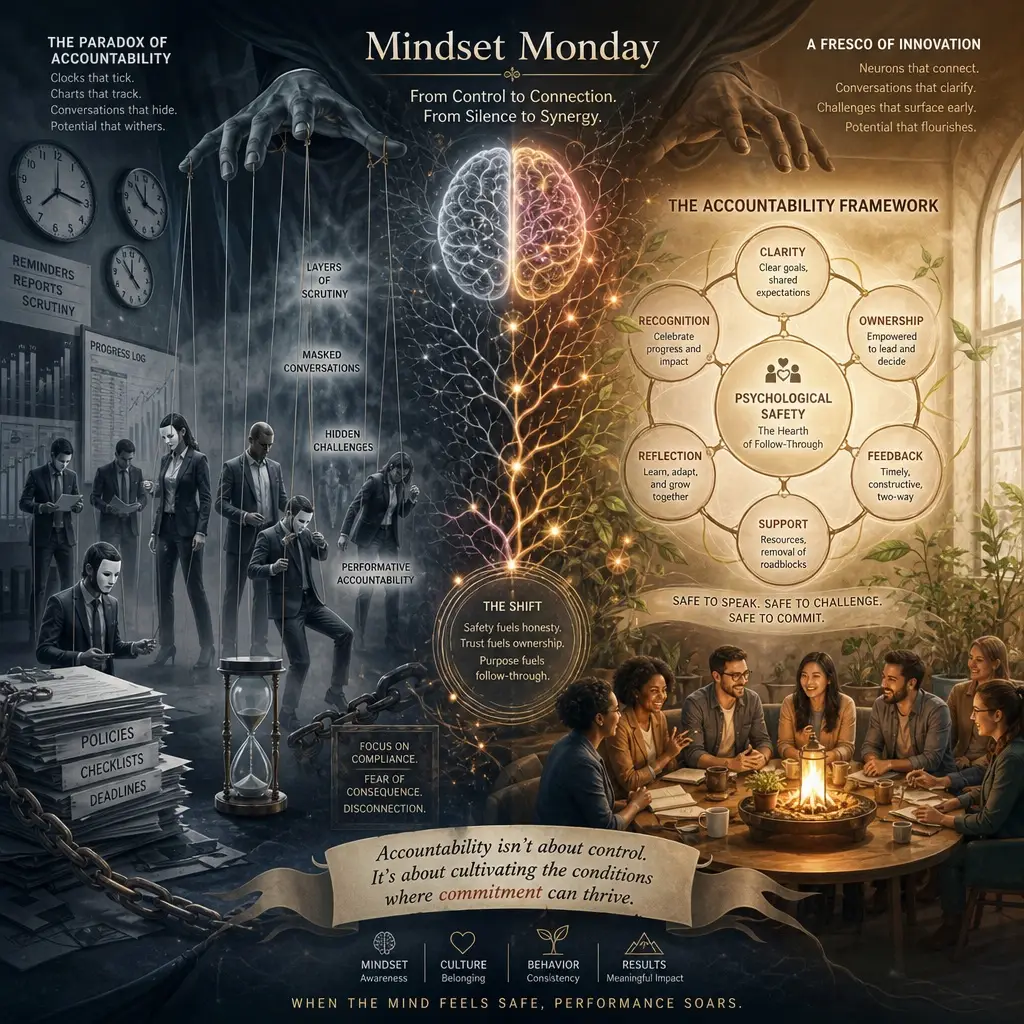
Accountability That Doesn’t Trigger Avoidance

Most leaders want the same thing: a team that follows through.

So we push for “ownership.” We ask, “Who owns this?” We add more tracking. More reminders. More pressure.

And then something predictable happens.

People get quieter. Updates get vaguer. Problems surface later. Accountability turns into a game of looking busy.

That’s not a character flaw.

It’s a brain response.

This Mindset Monday is about building accountability that doesn’t trigger avoidance—a neuroscience-informed system that creates follow-through and psychological safety.

The Five-Pillar Spine Mid-Year Re-commitment: A Leadership Operating System for the Next Two Quarters

Mid-year is when most leaders do one of two things:

Recommit to goals (often the same ones, with more pressure)

Quietly drift (because the year got loud)

But there’s a third option—and it’s the boundary-push:

Stop treating the next six months like a goal chase. Start treating it like an operating system.

Goals tell you what you want.

An operating system tells you how you’ll lead when you’re tired, busy, triggered, or uncertain.

That’s what the Five-Pillar Spine is for.

Not as inspiration.

As constraints that create freedom.

The Recovery Advantage: Why the Best Leaders Train “Nervous System Capacity,” Not Time Management

An,Early,Morning,Scene,In,A,Bustling,City,,Where,Skyscrapers

Most leaders don’t need another productivity hack.

They need a bigger capacity to stay clear, steady, and human when pressure rises.

Because here’s the boundary-push:

Your leadership ceiling is often set by your nervous system, not your calendar.

You can have the best strategy, the best intentions, and the best tools—yet still:

snap in a tense conversation

avoid a decision you know you need to make

over-function to keep things moving

lose empathy when you’re tired

That’s not a time-management problem.

That’s a capacity problem.

The 9-Competency Scorecard Reset: Stop Chasing Balance Start Designing Strategic Imbalance

Leadership growth doesn’t come from balance. It comes from leverage.

In the next six months, the leaders who make the biggest jump wont be the ones who try to improve all nine competencies at once.

They’ll be the ones who choose a purposeful focus a strategic imbalance and let that one shift create second-order gains everywhere else.

Leading Beyond the Role: How Purpose Expands Influence at Every Level

Mountain,Ridge,+,A,Luminous,Bridge/path,Connecting,People,At,Different

Leadership isn’t a title. It’s a choice—made in the moments where you decide to act with intention, not just react to circumstances.

If you’ve ever thought, “I’ll have more influence when I’m promoted,” this is your reminder: influence doesn’t start with authority. It starts with purpose.

In IronMind terms, purpose is the internal compass that helps you lead with clarity, courage, and consistency—no matter where you sit on the org chart.

From Intention to Influence: How Purposeful Messaging Creates Real Impact

mountains in the background, compass in the foreground with sun light being shone on the compass to provide direction.

Purpose does not create impact simply because it exists. It creates impact when leaders communicate it clearly, consistently, and credibly. Teams do not align around vague intention. They align around messages they can understand, trust, and apply.

This is why Purposeful Messaging is such a critical leadership competency. It helps leaders translate values into language, stories, and standards that people can remember and act on. As John C. Maxwell said, “People buy into the leader before they buy into the vision.” Credibility shapes whether purpose lands at all.

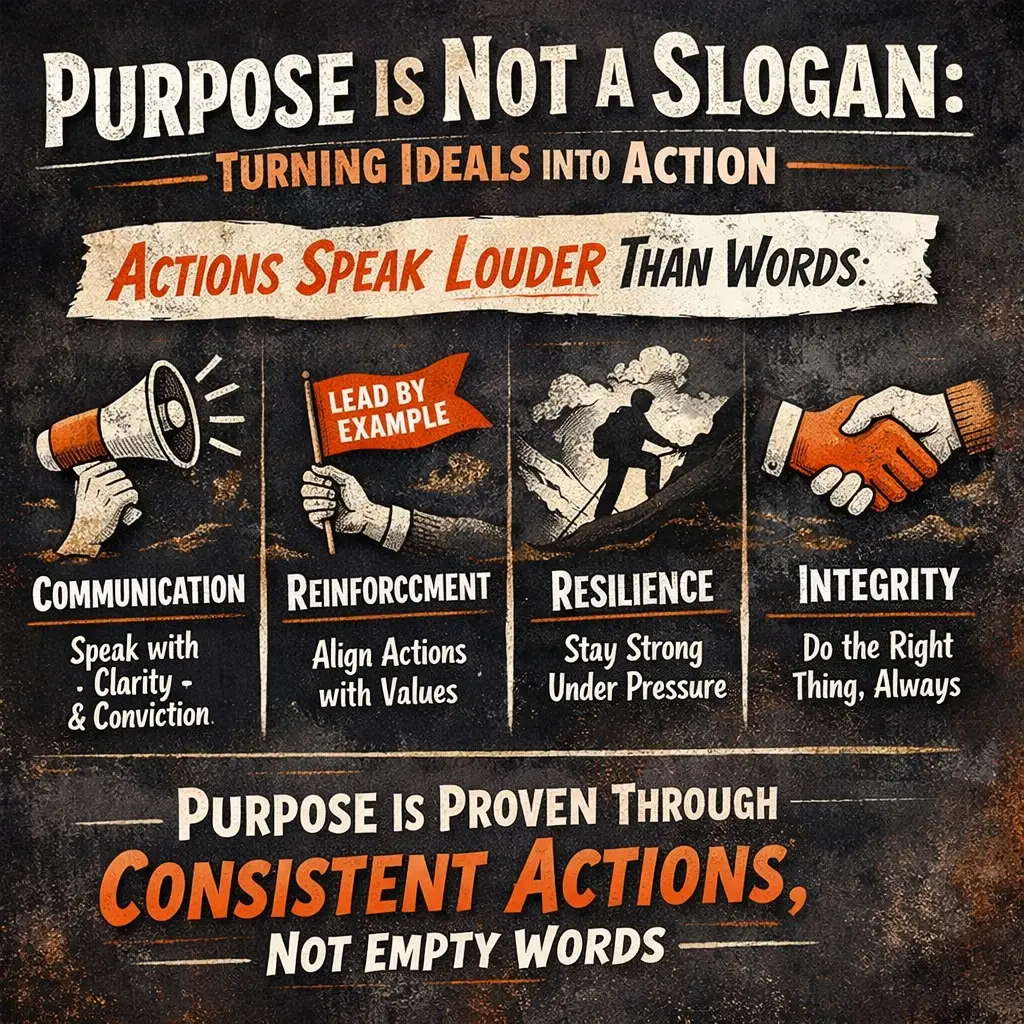
Purpose Is Not a Slogan: How Leaders Turn Values Into Daily Action

Purpose is easy to admire when it is framed well, printed beautifully, and repeated often. It is much harder to live.

In many organizations, purpose is treated like a positioning statement: something designed to inspire, unify, or differentiate. But leadership exposes whether purpose is truly operational or merely aspirational. Teams do not judge purpose by the elegance of its language. They judge it by the consistency of leadership behavior.