Accountability That Doesn’t Trigger Avoidance
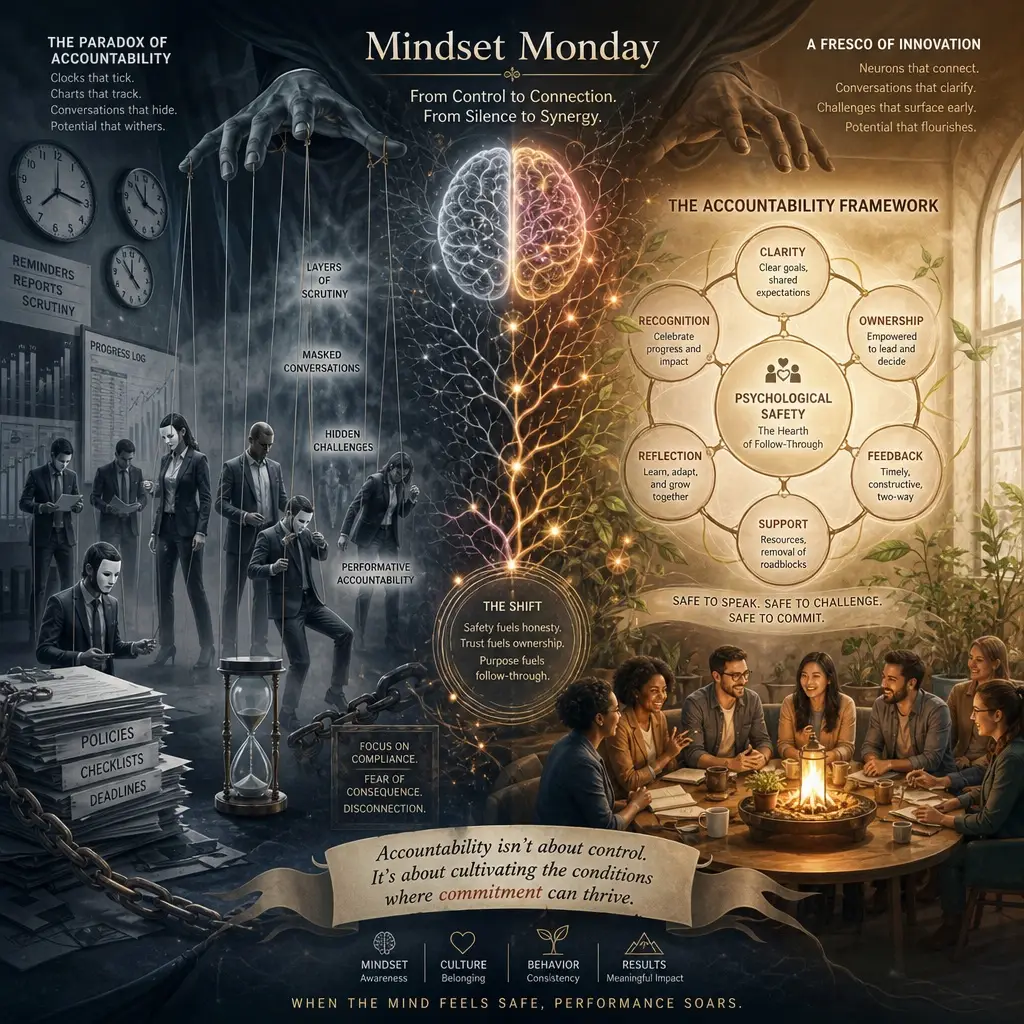
Most leaders want the same thing: a team that follows through.

So we push for “ownership.” We ask, “Who owns this?” We add more tracking. More reminders. More pressure.

And then something predictable happens.

People get quieter. Updates get vaguer. Problems surface later. Accountability turns into a game of looking busy.

That’s not a character flaw.

It’s a brain response.

This Mindset Monday is about building accountability that doesn’t trigger avoidance—a neuroscience-informed system that creates follow-through and psychological safety.


Stop Losing September: Rebuild Momentum in 72 Hours

a person climbing a mountain with clarity of goals one step at a time.

Back from summer, most leaders try to restart momentum by pushing harder. But your brain doesn’t rebuild momentum through pressure—it rebuilds it through prediction: clear goals, fewer open loops, and fast feedback.

Rest isn’t the absence of work—it’s a trained capability

IronMind Leadership & Performance - Mindfulness

You can’t out-discipline a nervous system that never downshifts.

Restfulness is not passive. It’s the ability to shift from sympathetic drive to parasympathetic recovery on purpose.

High performers often have the drive skill—but not the downshift skill. That’s why vacations don’t always fix burnout: your body goes away, but your nervous system stays “on.”

Mindfulness That Doesn’t Feel Like Another Task

IronMind Leadership - Breath Rest Lead

Micro-mindfulness for leaders: regulate in real time, not in theory

If mindfulness feels like homework, it won’t stick. The goal isn’t calm. The goal is state control.

The most useful mindfulness practice for leaders isn’t a 30-minute routine you’ll “start someday.” It’s a micro-reset embedded into the day you already have.

Time Integrity—The Hidden Skill Behind Sustainable Performance

IronMind Leadership & Performance - Time Integrity & Neuroscience

Time integrity beats time management (and your brain knows it) Your brain doesn’t burn out from work alone. It burns out from broken agreements with yourself. Here’s the pattern: you plan a day, then you override your plan—again. You push past your stop time, skip the walk, eat at your desk, answer “one more email.” … Read more

The Leadership Bottleneck: Why Your Team Keeps Bringing Every Problem Back to You

IronMind Leadership: The Leadership Bottleneck

If your team needs you to solve every problem…

You haven’t built a high-performing team.

You’ve built dependency.

Many leaders find themselves overwhelmed by constant requests, approvals, decisions, and escalations. Their calendars are full, their inboxes are overflowing, and they often feel like they’re carrying the weight of the entire organization.

Yet what if the problem isn’t workload?

What if the problem is leadership design?

The Five-Pillar Spine Mid-Year Re-commitment: A Leadership Operating System for the Next Two Quarters

Mid-year is when most leaders do one of two things:

Recommit to goals (often the same ones, with more pressure)

Quietly drift (because the year got loud)

But there’s a third option—and it’s the boundary-push:

Stop treating the next six months like a goal chase. Start treating it like an operating system.

Goals tell you what you want.

An operating system tells you how you’ll lead when you’re tired, busy, triggered, or uncertain.

That’s what the Five-Pillar Spine is for.

Not as inspiration.

As constraints that create freedom.

The Recovery Advantage: Why the Best Leaders Train “Nervous System Capacity,” Not Time Management

An,Early,Morning,Scene,In,A,Bustling,City,,Where,Skyscrapers

Most leaders don’t need another productivity hack.

They need a bigger capacity to stay clear, steady, and human when pressure rises.

Because here’s the boundary-push:

Your leadership ceiling is often set by your nervous system, not your calendar.

You can have the best strategy, the best intentions, and the best tools—yet still:

snap in a tense conversation

avoid a decision you know you need to make

over-function to keep things moving

lose empathy when you’re tired

That’s not a time-management problem.

That’s a capacity problem.

The 9-Competency Scorecard Reset: Stop Chasing Balance Start Designing Strategic Imbalance

Leadership growth doesn’t come from balance. It comes from leverage.

In the next six months, the leaders who make the biggest jump wont be the ones who try to improve all nine competencies at once.

They’ll be the ones who choose a purposeful focus a strategic imbalance and let that one shift create second-order gains everywhere else.