Can Your Team Disagree Without Coming Apart?

a leader contemplates their next move as teams debate an outcome over a round of tug-of-war

Two capable people disagree about a decision.

One sees a deadline the team cannot afford to miss. The other sees a risk the team cannot afford to ignore. Both care about the outcome. Neither feels heard.

Soon, the discussion shifts. People stop testing the idea and start questioning one another’s judgment. Others fall quiet. The meeting ends with a decision, but the tension follows everyone out of the room.
The Credibility of “I Don’t Know Yet”

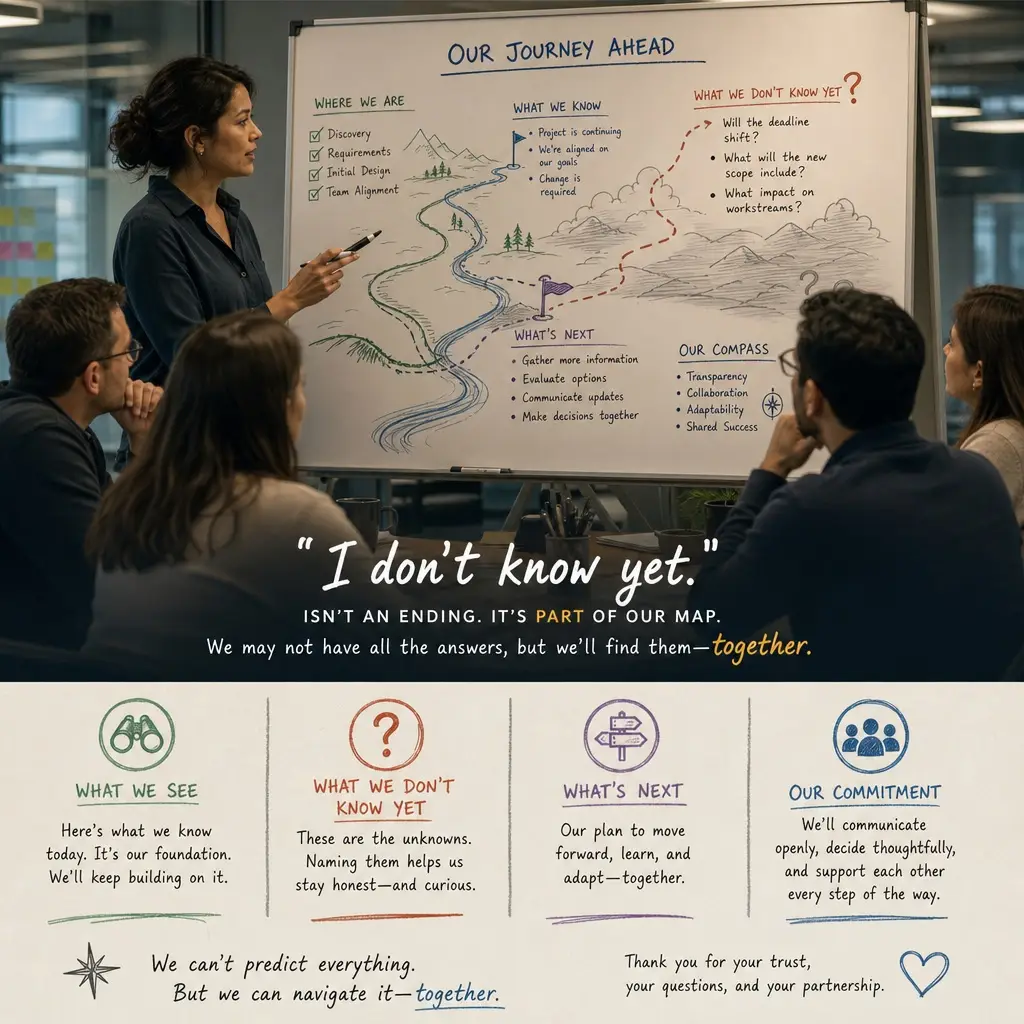
Talking through times of uncertainty using a whiteboard and markers and pictures.

Your team wants an answer.

Will the project continue? Is the deadline changing? What does the new direction mean for their work?

You have some information, but the decision is not final. So you face a familiar leadership dilemma: speak with confidence you cannot justify, or admit that you do not know yet.

There is a third responsibility: give people an honest account of what is uncertain and a clear path through it.

“I don’t know yet” can be a credible answer. It cannot be the entire answer.

“My Door Is Open” Isn’t Enough: Why Teams Still Stay Silent

Leaders discuss where communication and trust went wrong around a board room table.

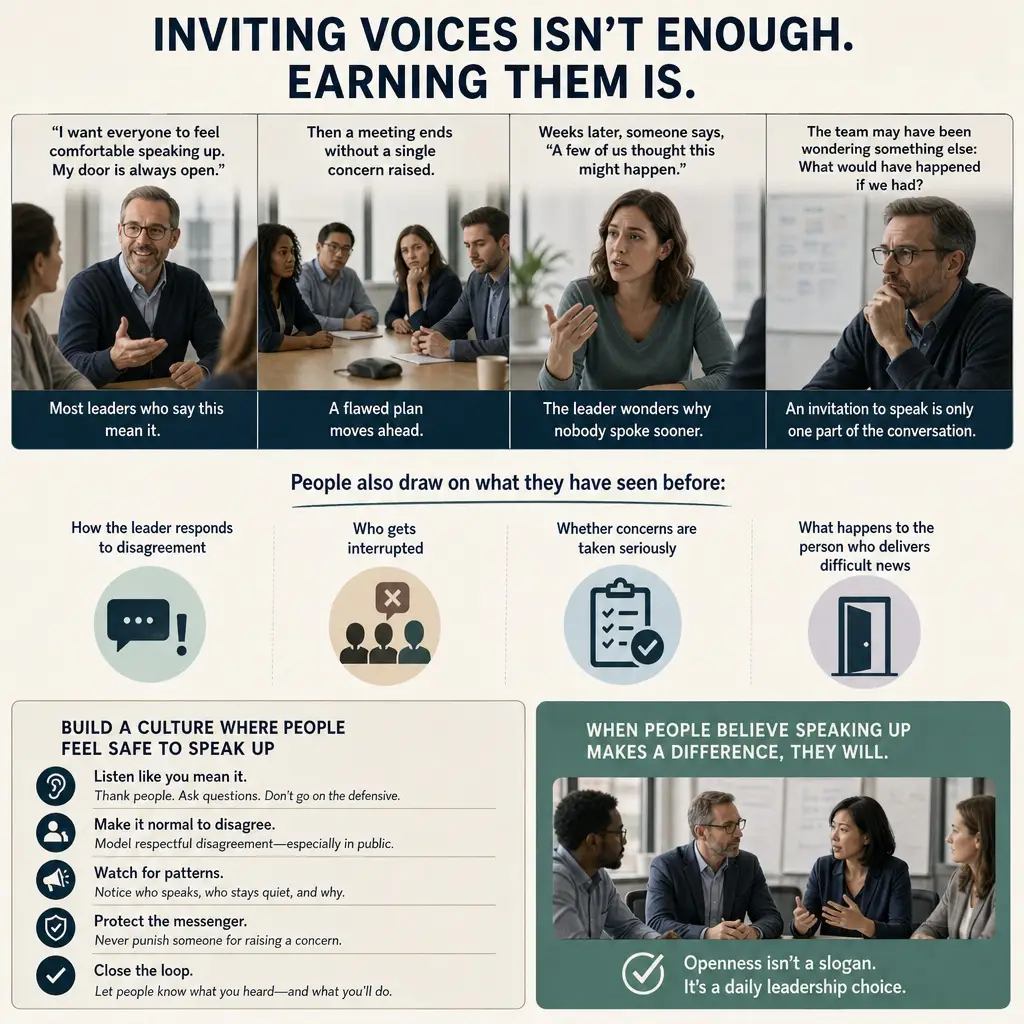
“I want everyone to feel comfortable speaking up. My door is always open.”

Most leaders who say this mean it. Then a meeting ends without a single concern raised. A flawed plan moves ahead. Weeks later, someone says, “A few of us thought this might happen.”

The leader wonders why nobody spoke sooner.

The team may have been wondering something else: What would have happened if we had?

An invitation to speak is only one part of the conversation. People also draw on what they have seen before: how the leader responds to disagreement, who gets interrupted, whether concerns are taken seriously, and what happens to the person who delivers difficult news.

When AI Writes the Message, Who Earns the Trust?

AI, Communication & Leadership, a leader contemplates the message they are about to send.

A leader has difficult news to share. A decision has changed, a deadline has slipped, or a team member’s work has fallen short.

They ask AI to help draft the message. Seconds later, the words are clear, polished, and reassuring.

But there is a question worth asking before they press send:

Does this message sound like someone who understands what people are going through—and is prepared to stand behind every word?

AI can make writing faster. It can help organize a complex update, remove unnecessary jargon, and reveal where a message may be unclear. Those are useful capabilities. Yet leadership communication carries more than information. It carries responsibility for the decision, respect for the people affected, and a commitment to what happens next.

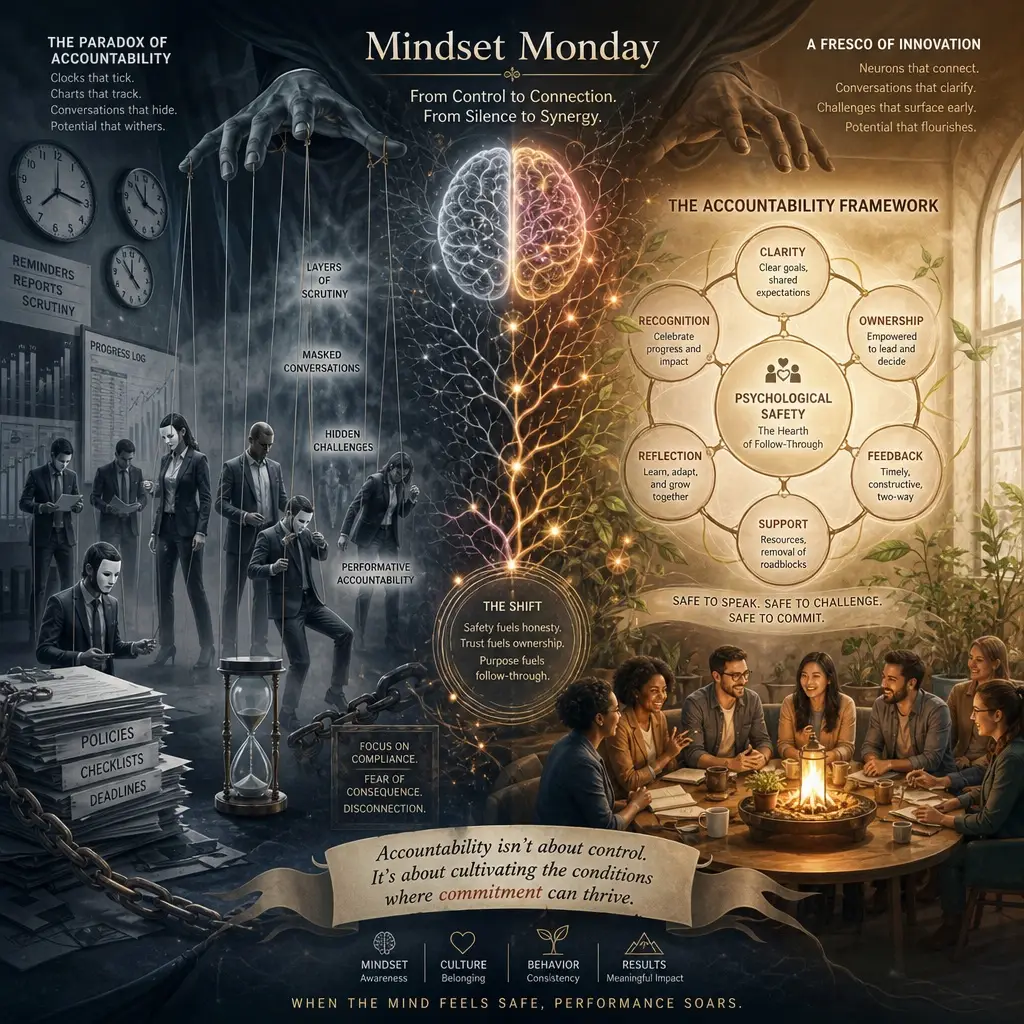
Accountability That Doesn’t Trigger Avoidance

Most leaders want the same thing: a team that follows through.

So we push for “ownership.” We ask, “Who owns this?” We add more tracking. More reminders. More pressure.

And then something predictable happens.

People get quieter. Updates get vaguer. Problems surface later. Accountability turns into a game of looking busy.

That’s not a character flaw.

It’s a brain response.

This Mindset Monday is about building accountability that doesn’t trigger avoidance—a neuroscience-informed system that creates follow-through and psychological safety.

Stop Losing September: Rebuild Momentum in 72 Hours

a person climbing a mountain with clarity of goals one step at a time.

Back from summer, most leaders try to restart momentum by pushing harder. But your brain doesn’t rebuild momentum through pressure—it rebuilds it through prediction: clear goals, fewer open loops, and fast feedback.

Rest isn’t the absence of work—it’s a trained capability

IronMind Leadership & Performance - Mindfulness

You can’t out-discipline a nervous system that never downshifts.

Restfulness is not passive. It’s the ability to shift from sympathetic drive to parasympathetic recovery on purpose.

High performers often have the drive skill—but not the downshift skill. That’s why vacations don’t always fix burnout: your body goes away, but your nervous system stays “on.”

Mindfulness That Doesn’t Feel Like Another Task

IronMind Leadership - Breath Rest Lead

Micro-mindfulness for leaders: regulate in real time, not in theory

If mindfulness feels like homework, it won’t stick. The goal isn’t calm. The goal is state control.

The most useful mindfulness practice for leaders isn’t a 30-minute routine you’ll “start someday.” It’s a micro-reset embedded into the day you already have.

The Five-Pillar Spine Mid-Year Re-commitment: A Leadership Operating System for the Next Two Quarters

Mid-year is when most leaders do one of two things:

Recommit to goals (often the same ones, with more pressure)

Quietly drift (because the year got loud)

But there’s a third option—and it’s the boundary-push:

Stop treating the next six months like a goal chase. Start treating it like an operating system.

Goals tell you what you want.

An operating system tells you how you’ll lead when you’re tired, busy, triggered, or uncertain.

That’s what the Five-Pillar Spine is for.

Not as inspiration.

As constraints that create freedom.

The Recovery Advantage: Why the Best Leaders Train “Nervous System Capacity,” Not Time Management

An,Early,Morning,Scene,In,A,Bustling,City,,Where,Skyscrapers

Most leaders don’t need another productivity hack.

They need a bigger capacity to stay clear, steady, and human when pressure rises.

Because here’s the boundary-push:

Your leadership ceiling is often set by your nervous system, not your calendar.

You can have the best strategy, the best intentions, and the best tools—yet still:

snap in a tense conversation

avoid a decision you know you need to make

over-function to keep things moving

lose empathy when you’re tired

That’s not a time-management problem.

That’s a capacity problem.