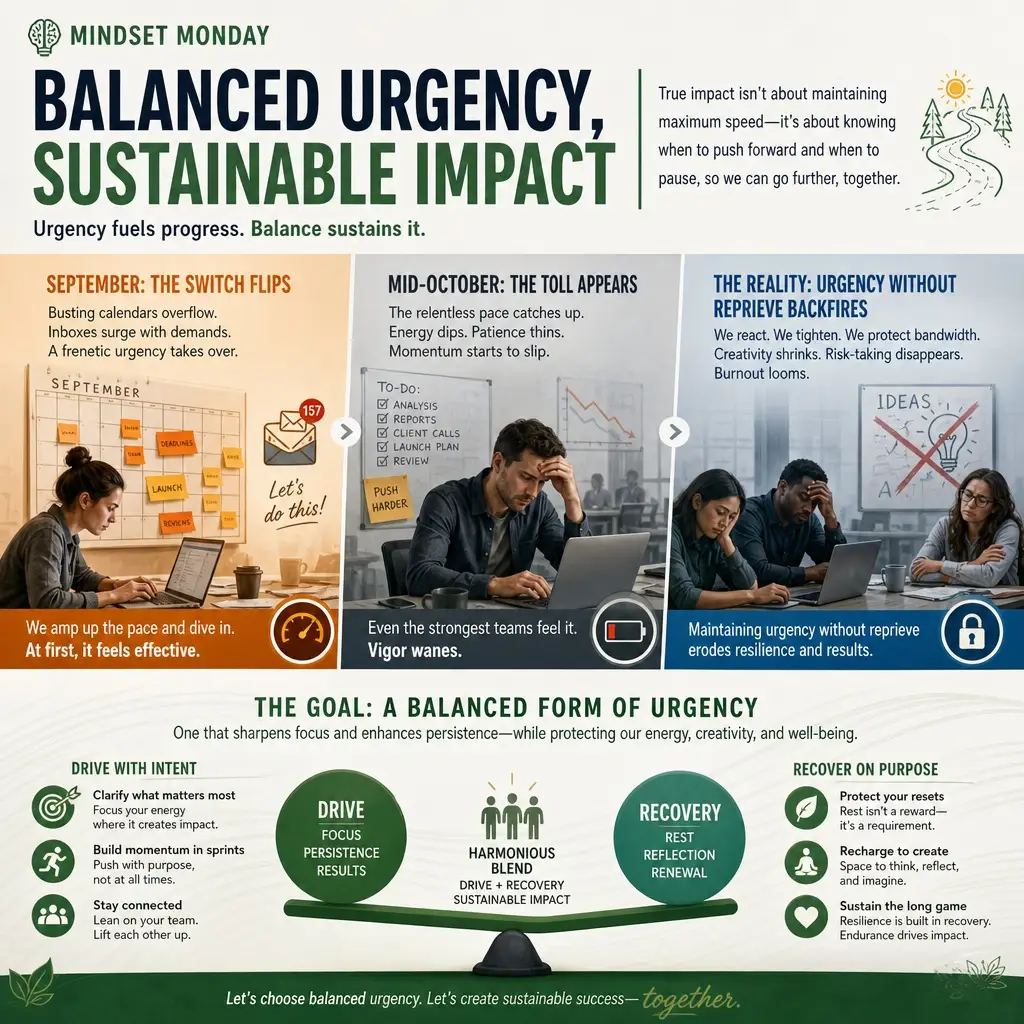
September has a way of flipping a switch. Calendars fill up, inboxes spike, and suddenly everything feels like it’s due yesterday. The default move is predictable: push harder.
And for a little while, it works.
But if you’ve ever watched a strong team lose steam by mid-October—more reactive, more brittle, less creative—you already know the truth:
Urgency without recovery doesn’t create performance. It creates fragility.
This Mindset Monday is about building sustainable urgency—the kind that drives focus and follow-through without triggering the stress spiral that leads to burnout.
Why “push harder” works—until it doesn’t
“Push harder” works in the short term because your nervous system can mobilize quickly. Under pressure, your brain prioritizes speed, narrows attention, and allocates energy toward immediate action.
That’s useful—until it becomes the only mode you operate in.
When urgency becomes constant, leaders start paying hidden costs:
- Shorter tempers and lower patience
- More miscommunication and less psychological safety
- Decision fatigue and reactive prioritization
- Reduced creativity and strategic thinking
The problem isn’t urgency. The problem is urgency with no off-ramp.
Stress isn’t the enemy; chronic threat is
Stress is not automatically bad. In fact, short bursts of stress can sharpen performance.
What breaks leaders (and teams) is chronic threat—the ongoing sense that:
- failure isn’t safe
- mistakes will be punished
- there’s never enough time
- everything is urgent and nothing is clear
When the brain interprets the environment as threat-heavy, it shifts into protection mode. That’s when you see more defensiveness, more control, more avoidance, and more burnout.
The IronMind M.O.M.E.N.T.U.M. move:
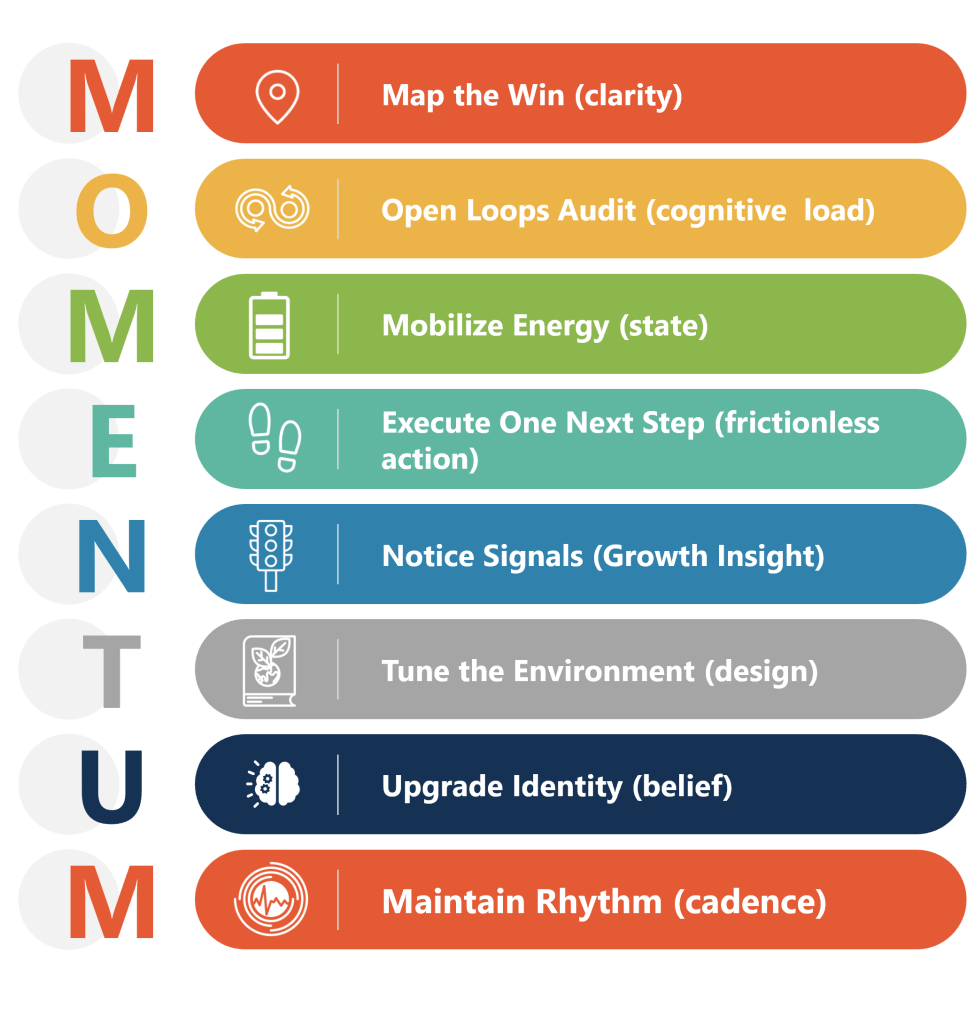
M — Mobilize energy.
Mobilizing energy isn’t about hype. It’s about helping your brain and body access challenge-state energy (focused, capable, forward-moving) instead of threat-state energy (tense, reactive, tunnel-vision).
The goal is simple:
Create urgency that feels like purpose—not panic.
Threat vs challenge: the leadership lever most people ignore
Here’s the lever: the brain responds differently when pressure is framed as a threat versus a challenge.
- Threat state: “If we fail, we’re in trouble.”
- Challenge state: “This matters—and we can handle it.”
Both involve pressure. Only one supports sustainable performance.
Leaders influence this more than they realize—through tone, clarity, timelines, and how they respond when things go sideways.
The pace problem: intensity without recovery becomes fragility
High performance requires intensity.
But intensity without recovery is like sprinting on a sprained ankle: you might still move fast, but you’re accumulating damage.
If your team is always “on,” you’ll eventually see:
- more sick days
- more errors
- more conflict
- more disengagement
Sustainable urgency means you pair intensity with recovery—on purpose.
3 practices to create sustainable urgency
These are simple, neuroscience-aligned practices you can use this week to keep urgency productive.
Practice 1: the 2-minute Challenge-State opener
Before a high-pressure meeting, take two minutes to shift the room from threat to challenge.
Try this opener:
- What matters most about this? (purpose)
- What does “good” look like by the end of this meeting? (clarity)
- What’s one constraint we’ll work with—not fight? (reality)
- What’s one strength we can lean on right now? (capability)
You’re not reducing urgency—you’re reducing panic.
Practice 2: replace “ASAP” with clarity (by when/why/what breaks)
“ASAP” is a threat amplifier. It signals urgency without structure, and it forces the receiver to guess priorities.
Replace it with three clarifiers:
- By when do you need it?
- Why does it matter?
- What breaks if it’s late?
Example:
Instead of: “Can you get this to me ASAP?”
Try: “Can you send this by 3:00pm tomorrow? It’s needed for the client review. If it’s late, we risk going in without alignment.”
Same urgency. Far less threat.
Practice 3: the 3:1 Recovery Rule (micro-downshifts)
You don’t need a week off to recover. You need micro-downshifts built into the day.
Use a simple rule:
For every 3 units of intensity, schedule 1 unit of recovery.
Recovery can be small:
- a 90-second breathing reset
- a short walk between meetings
- 10 minutes of quiet focus before a decision
- a “no agenda” buffer block
The point is to teach your nervous system: we can work hard without staying in threat.
Preparing for winter: design recovery into the system now
Fall burnout doesn’t start in November. It starts in September—when leaders build schedules that assume unlimited capacity.
If you want sustainable urgency, design it into the system:
- Meeting hygiene: fewer meetings, better agendas, clear outcomes
- Focus blocks: protected time for deep work (not just “when I get a chance”)
- Decision windows: set times for decisions so everything isn’t urgent all the time
Your calendar is either a performance system—or a stress machine.
Try this today
Pick one high-pressure request you’re about to send.
Before you hit send, rewrite it as a low-threat, high-clarity promise.
Use this template:
- “Can you deliver [what] by [when]?
- It matters because [why].
- If it’s late, [what breaks].
- If you see a risk, flag it by [earlier time] so we can adjust.”
That’s sustainable urgency.
It keeps the pace high—and the nervous system steady.