
In today’s hyper-connected world, leaders face an unprecedented challenge: managing an endless stream of demands while maintaining focus on what truly matters. The difference between reactive managers and visionary leaders often comes down to one critical skill—strategic time management.
Enter the Eisenhower Matrix, a deceptively simple yet profoundly powerful tool that has never been more crucial for modern leadership success.
What Is the Eisenhower Matrix?
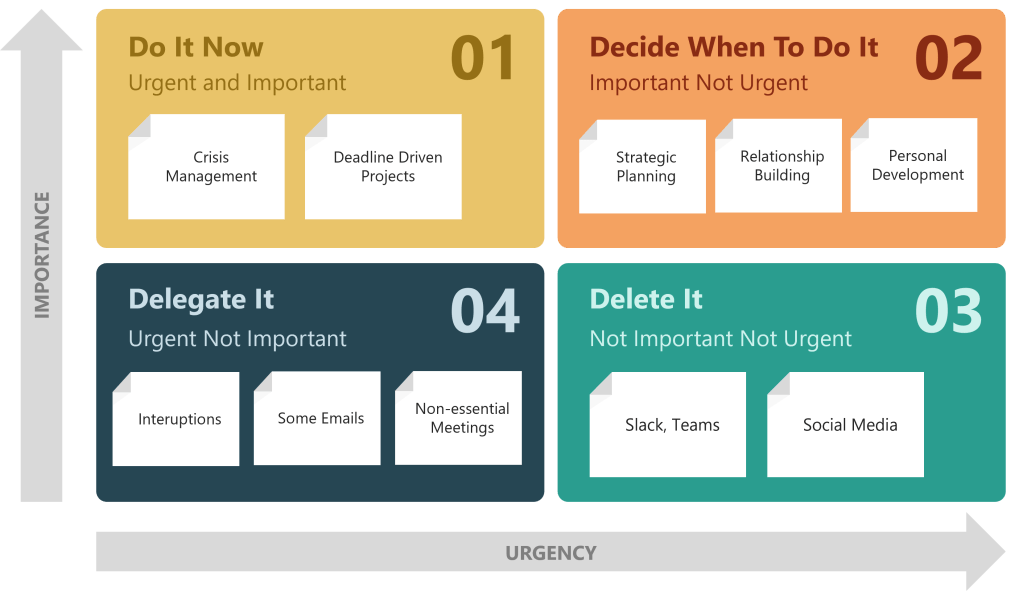
Named after President Dwight D. Eisenhower, who famously said, “What is important is seldom urgent, and what is urgent is seldom important,” this framework divides your tasks into four quadrants:
- Quadrant 1: Urgent & Important – Crisis management, pressing deadlines, emergencies
- Quadrant 2: Not Urgent but Important – Strategic planning, relationship building, professional development, prevention
- Quadrant 3: Urgent but Not Important – Interruptions, some emails, other people’s priorities
- Quadrant 4: Not Urgent & Not Important – Time wasters, busywork, mindless scrolling
The matrix doesn’t just organize tasks—it transforms how you think about leadership itself.
Why This Matters More Than Ever for Leaders
Today’s leaders are drowning in digital noise. Slack notifications, back-to-back meetings, urgent emails—the tyranny of the urgent has never been more relentless. Without a strategic framework, you’re not leading; you’re simply reacting.
Research shows that leaders who master time management are:
- 37% more effective at strategic decision-making
- 42% better at building high-performing teams
- 53% more likely to achieve work-life integration
The Eisenhower Matrix provides the clarity you need to break free from reactive patterns and step into intentional leadership.
Three Game-Changing Applications
1. Defensive Calendaring: Protecting Your Strategic Time
Defensive calendaring isn’t about saying no to everything—it’s about saying yes to what matters most. By applying the Eisenhower Matrix to your calendar:
- Block Quadrant 2 time first – Schedule your strategic thinking, team development, and innovation sessions before anything else fills your calendar
- Create buffer zones – Build in transition time between meetings to process, reflect, and recalibrate
- Establish “no-meeting” blocks – Protect deep work time for high-impact activities that require sustained focus
- Audit recurring meetings – Challenge every standing meeting: Is this Quadrant 1 or 2, or has it drifted into Quadrant 3?
Your calendar should reflect your priorities, not just your availability. When you defensively calendar Quadrant 2 activities, you’re investing in prevention rather than constantly fighting fires.
2. Project Prioritization: Leading with Strategic Clarity
Not all projects deserve equal attention. The Eisenhower Matrix helps you:
- Identify strategic initiatives – Quadrant 2 projects that drive long-term value often get postponed for urgent but less important work
- Delegate effectively – Quadrant 3 tasks are perfect development opportunities for emerging leaders on your team
- Eliminate ruthlessly – Quadrant 4 projects drain resources without delivering results; have the courage to stop them
- Resource appropriately – Allocate your best people and resources to Quadrant 2 initiatives, not just crisis management
When you prioritize projects through this lens, you shift from managing tasks to leading transformation.
3. Daily Activities: The Foundation of Productive Leadership
How you process daily activities determines your leadership effectiveness. Apply the matrix every morning:
- Start with Quadrant 2 – Tackle one strategic activity before checking email
- Batch Quadrant 3 tasks – Handle routine communications in dedicated time blocks
- Question everything – Before accepting any task, ask: “Which quadrant is this really in?”
- Track your time – Spend one week logging where your time actually goes—most leaders are shocked by the results
Finding Your Optimal Leadership Mix
Here’s a truth every leader must embrace: there is no one-size-fits-all formula. Your optimal mix of operational activities, management responsibilities, leadership initiatives, and professional development is unique to your role, organization, and leadership stage.
However, research and our experience with hundreds of leaders reveals some guiding principles:
- Emerging leaders – 45% operational, 30% management, 15% leadership/strategic, 10% professional development
- Mid-level leaders – 25% operational, 35% management, 25% leadership/strategic, 15% professional development
- Senior executives – 10% operational, 25% management, 45% leadership/strategic, 20% professional development
Notice that professional development allocation increases as you advance in leadership. This isn’t counterintuitive—it’s essential. The higher you climb, the more critical it becomes to stay ahead of industry trends, emerging technologies, and evolving leadership practices.
Professional Development: The Non-Negotiable Quadrant 2 Investment
Here’s a leadership truth that separates good organizations from great ones: time allocated for professional development demonstrates a learning mindset culture—and that culture is critical for innovative and cutting-edge solution development.
When leaders visibly prioritize their own growth, they send a powerful message throughout the organization: learning isn’t a luxury; it’s a strategic imperative.
Why Professional Development Lives in Quadrant 2
Professional development is the quintessential Quadrant 2 activity—important but rarely urgent. It never screams for your attention like a crisis or a deadline. Yet it’s the foundation of:
- Innovation capacity – Exposure to new ideas, frameworks, and perspectives fuels creative problem-solving
- Competitive advantage – Leaders who continuously learn keep their organizations ahead of disruption
- Team culture – When you invest in your growth, your team feels permission and encouragement to do the same
- Adaptive leadership – The skills that got you here won’t get you there; continuous development ensures relevance
- Psychological safety – Leaders who model learning create environments where experimentation and growth are celebrated
What Professional Development Actually Looks Like
Professional development isn’t just attending an annual conference. It’s a consistent, intentional practice woven into your leadership rhythm:
- Structured learning – Leadership programs, certifications, executive education, coaching engagements
- Peer learning – Mastermind groups, leadership forums, cross-industry networking
- Reading & research – Books, journals, case studies, thought leadership articles (30-60 minutes daily)
- Experimentation – Pilot projects, stretch assignments, learning through controlled risk-taking
- Reflection – Journaling, debriefs, after-action reviews, coaching conversations
- Teaching others – Mentoring, presenting, writing—teaching deepens your own mastery
Building a Learning Mindset Culture
When you protect time for professional development in your calendar, you’re doing more than improving your own capabilities—you’re architecting organizational culture.
Organizations with strong learning cultures are:
- 92% more likely to develop innovative products and processes
- 52% more productive than their peers
- 56% more likely to be first to market with new solutions
- 17% more profitable than organizations without learning cultures
A learning mindset culture doesn’t emerge by accident. It’s cultivated through visible leadership behaviors:
- Model vulnerability – Share what you’re learning and where you’re struggling
- Celebrate learning failures – Reward intelligent risk-taking, even when it doesn’t work out
- Allocate resources – Budget for development, protect time for learning, invest in growth opportunities
- Make it visible – Share insights from conferences, discuss books in team meetings, apply new frameworks publicly
- Tie it to strategy – Connect learning initiatives to business outcomes and innovation goals
The Innovation Connection
Cutting-edge solution development doesn’t happen in a vacuum. It emerges from environments where:
- Leaders are exposed to diverse perspectives and emerging trends
- Teams feel safe to experiment and challenge the status quo
- Continuous learning is woven into the operational fabric
- Professional development is seen as strategic investment, not discretionary expense
When you block 10-20% of your time for professional development, you’re not taking time away from “real work”—you’re ensuring your real work stays relevant, innovative, and impactful.
The most innovative leaders understand this paradox: you must step away from the work to transform the work.
Connecting to the 9-Competency Leadership Model

At IronMind Leadership, we’ve found that the Eisenhower Matrix powerfully reinforces multiple competencies in our evidence-based framework:
Strategic Insight – The matrix trains your brain to think strategically about time allocation, developing your ability to see patterns and prioritize based on long-term impact rather than short-term pressure.
Execution & Accountability – By clarifying what truly matters, you execute with precision and hold yourself accountable to your highest priorities, not just the loudest demands.
Growth Mindset – Embracing the matrix requires acknowledging that your current time management approach may not be serving you. This self-awareness and willingness to change is the foundation of continuous growth. Protecting time for professional development is the ultimate expression of growth mindset in action.
Emotional Intelligence – Understanding the difference between urgent and important requires emotional regulation—the ability to resist the dopamine hit of checking off urgent tasks in favor of meaningful Quadrant 2 work.
Purposeful Messaging – When you’re clear about your priorities, you communicate them more effectively to your team, creating alignment and reducing unnecessary urgency.
Building the Habit: Your 90-Day Transformation
Knowledge without application is just information. To truly transform your leadership, you need to build the Eisenhower Matrix into your daily operating system. Here’s your 90-day habit formation cycle:
Days 1-30: Awareness & Foundation
- Week 1 – Track everything. Log every task and meeting in a quadrant for one full week without changing behavior
- Week 2 – Analyze your patterns. Where are you spending most of your time? What surprises you? How much time are you investing in professional development?
- Week 3 – Set your target mix. Based on your role, define your ideal percentage split across operational, management, leadership, and professional development activities
- Week 4 – Start small. Choose one Quadrant 2 activity to protect three times this week, including at least one professional development block
Days 31-60: Integration & Adjustment
- Week 5-6 – Morning ritual. Spend 10 minutes each morning categorizing your day’s activities
- Week 7 – Defensive calendaring. Block Quadrant 2 time for the next month, including weekly professional development sessions
- Week 8 – Delegation practice. Identify three Quadrant 3 tasks to delegate or eliminate, freeing time for strategic work and learning
Days 61-90: Mastery & Refinement
- Week 9-10 – Measure impact. Track how your effectiveness has improved in key leadership areas. What new insights from your professional development are you applying?
- Week 11 – Team application. Teach the matrix to your team and apply it to team priorities. Share what you’re learning and create space for team development
- Week 12 – Reflect and recommit. Assess your progress and set your next 90-day goal. What will you learn next quarter?
Neuroscience tells us that it takes 21 days to form a habit and 90 days to create lasting behavioral change. By following this structured approach, you’re not just learning a tool—you’re rewiring your leadership brain.
The Quadrant 2 Leadership Revolution
Here’s the transformational insight that changes everything: Great leaders live in Quadrant 2.
When you consistently invest time in important but not urgent activities—strategic planning, relationship building, professional development, prevention, and innovation—you dramatically reduce Quadrant 1 crises. You move from reactive to proactive, from firefighting to fire prevention.
This is where leadership magic happens:
- You build the relationships that make difficult conversations easier
- You develop the strategies that prevent tomorrow’s crises
- You invest in people before you desperately need them to perform
- You innovate before disruption forces your hand
- You learn continuously so you lead confidently through uncertainty
Your Next Step: From Insight to Impact
The Eisenhower Matrix is more than a productivity hack—it’s a leadership philosophy. It challenges you to ask the most important question a leader can ask: “Am I spending my time on what truly matters?”
Starting today, you can begin your transformation:
- Download the matrix and print it
- Spend 15 minutes categorizing tomorrow’s planned activities
- Block one hour of Quadrant 2 time on your calendar for next week—make at least one session professional development
- Share the framework with one colleague or team member
- Identify one learning goal for this quarter and schedule time to pursue it
Remember, every moment you invest in Quadrant 2 today is a crisis you won’t have to manage tomorrow. Every strategic decision you make from a place of clarity rather than urgency compounds into transformational leadership impact. And every hour you dedicate to professional development multiplies your capacity to lead innovation and drive cutting-edge solutions.
The question isn’t whether you have time for strategic time management and professional development. The question is: Can you afford not to?
“The key is not to prioritize what’s on your schedule, but to schedule your priorities.” – Stephen Covey
Your leadership journey is a mountain worth climbing. The Eisenhower Matrix is your compass. Professional development is your training. Where will you point them?
Ready to transform your leadership effectiveness? The Eisenhower Matrix is just one of the evidence-based frameworks we integrate into our Leadership Edge Program. In 10 months, you’ll master 9 core leadership competencies, build sustainable habits, achieve measurable results, and cultivate a growth mindset that drives innovation throughout your organization.
Book your free consultation today and discover how strategic time management and intentional professional development can unlock your full leadership potential.In today’s hyper-connected world, leaders face an unprecedented challenge: managing an endless stream of demands while maintaining focus on what truly matters. The difference between reactive managers and visionary leaders often comes down to one critical skill—strategic time management.